What Are the OSHA Requirements for Fume Extraction in Manufacturing?
If you manage a manufacturing facility, you've likely asked this question — or had it asked of you. OSHA requirements around fume extraction can feel complex, and the consequences of getting it wrong go beyond regulatory fines. Poor air quality puts workers at risk, drives up healthcare costs, and creates liability that no safety manager wants to navigate.
This Air Quality Awareness Week, we're breaking down exactly what OSHA expects when it comes to fume extraction in manufacturing environments, what those requirements mean in practice, and how source capture technology is the most effective way to meet them.
Does OSHA Certify Fume Extractors?
This is one of the most common questions we hear — and the answer often surprises people.
OSHA does not issue product-level certifications for fume extractors or air filtration systems. Rather than approving specific equipment, OSHA regulates outcomes — meaning it holds employers responsible for controlling worker exposure to hazardous airborne contaminants and maintaining safe conditions on the floor.
What this means for you: the burden is on your facility to demonstrate that you are actively controlling fume and particulate exposure. The equipment you choose is the vehicle for meeting that obligation.Learn how Fumex approaches this differently with Source Capture Technology
What Does OSHA Actually Require?
OSHA's air quality requirements for manufacturing fall under several key standards:
Permissible Exposure Limits (PELs) — OSHA establishes maximum allowable concentrations of hazardous substances in the air workers breathe, measured over an eight-hour workday. These limits apply to hundreds of chemicals, including VOCs, solvents, metal fumes, and particulate matter commonly generated in printing, welding, laser processing, and chemical manufacturing.
The General Duty Clause (Section 5(a)(1) — Even where no specific PEL exists for a substance, OSHA's General Duty Clause requires employers to provide a workplace free from recognized hazards that are causing or likely to cause death or serious physical harm. In plain terms: if fumes are being generated in your facility, you are expected to do something about them.
Engineering Controls as the Preferred Solution — OSHA's hierarchy of controls places engineering controls — physical modifications to the work environment that reduce or eliminate exposure — above administrative controls and personal protective equipment (PPE). Fume extraction systems are engineering controls. OSHA consistently prefers them over relying on respirators alone.
Why Source Capture Is the Gold Standard
Not all fume extraction approaches are equal in OSHA's eyes — or in practice.
Ambient air filtration systems work by circulating and filtering the general air in a room. They can improve overall air quality, but they allow fumes to disperse throughout the workspace before being captured — meaning workers are exposed during that window.
Source Capture Fume Extraction eliminates contaminants at the point of emission, before they ever enter the breathing zone. This is the approach OSHA favors because it directly addresses the exposure pathway rather than managing it after the fact.
At Fumex, source capture is the foundation of everything we build. With over 30 years of experience and more than 20,000 installations worldwide, our systems are engineered to capture harmful fumes, gases, and particulate right where they are generated — protecting your team and keeping your operation compliant.
Fume Extraction for Common Manufacturing Applications
OSHA's requirements apply across a wide range of industrial processes. Here's how fume extraction fits into some of the most common:
Printing Operations — Industrial inkjet printing using MEK and solvent-based inks, as well as laser printing for coding, marking, and large-format applications, generates VOCs and chemical fumes that fall under OSHA's PEL framework. Fumex laser printing fume extraction systems are engineered to remove 99.97% of harmful gases produced during the printing process, available in both permanent and portable configurations for easy integration into virtually any print environment.
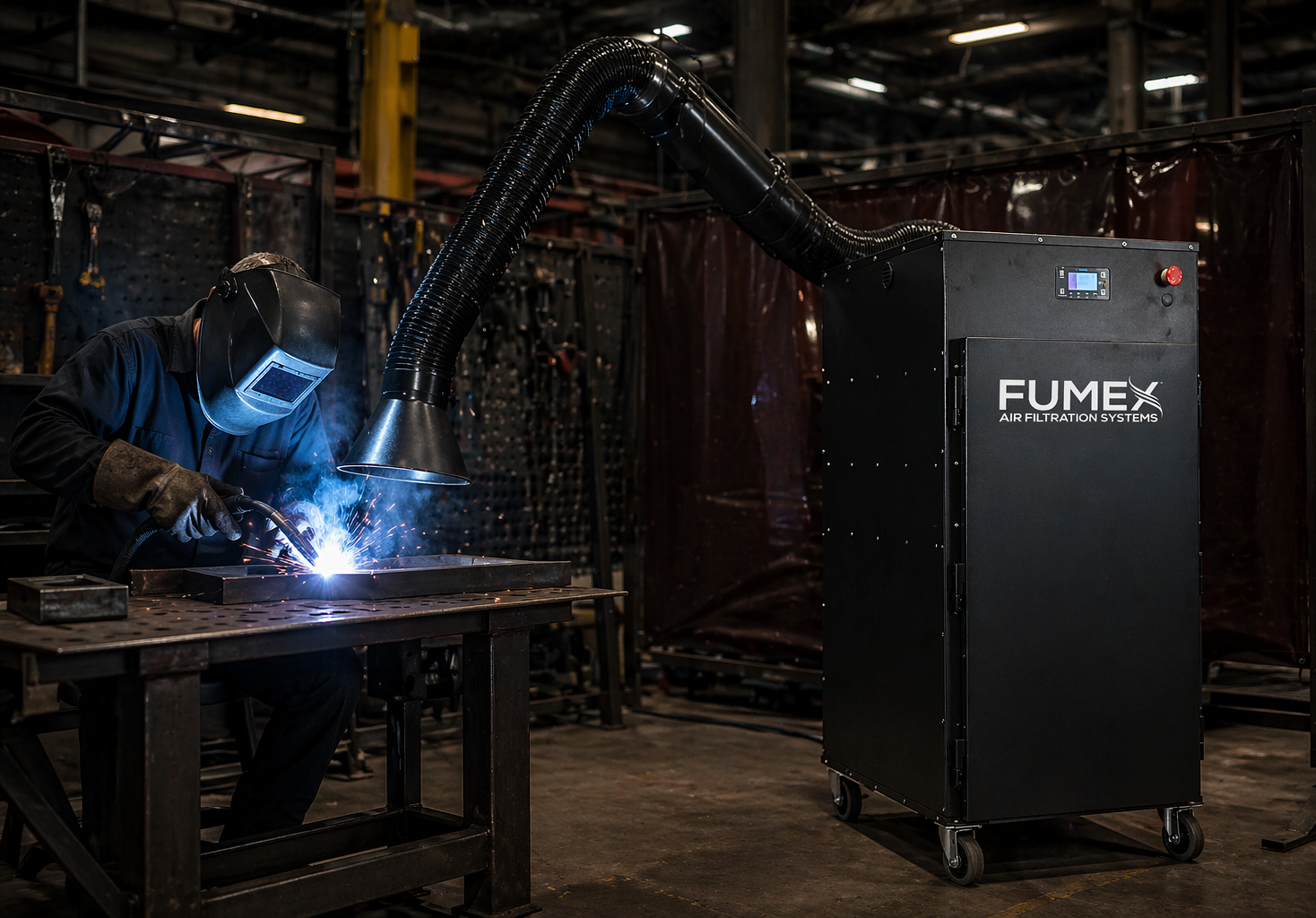
Welding — Welding fume is one of OSHA's most scrutinized exposure categories. The agency tightened its PEL for hexavalent chromium and manganese significantly in recent years. Source capture arms and hoods positioned at the weld point are the most effective control method.
Laser Processing — Laser cutting, engraving, and marking vaporize materials and generate fine particulate and chemical byproducts that require dedicated extraction. Fumex laser fume extractors are designed to work with all laser manufacturers and integrate into any environment.
Soldering and Electronics Manufacturing — Flux fumes from wave soldering, reflow ovens, and hand soldering contain rosin-based compounds that OSHA classifies as respiratory sensitizers. Source capture at the point of the iron or oven is the recommended control.
Chemical and Plastic Applications — Processes involving solvents, adhesives, resins, and plastics can release a wide range of hazardous vapors. Fumex systems can be fitted with broad-spectrum or application-specific activated carbon filters to address the precise chemistry of your process.
What Makes a Fume Extractor OSHA-Supportive?
When evaluating a fume extraction system for regulatory compliance, here's what to look for:
HEPA Filtration — HEPA filters capture 99.97% of particulates at 0.3 microns and smaller, addressing the fine particle fractions most harmful to respiratory health.
Gas and Odor Filtration — Activated carbon or specialty impregnated carbon filters address VOCs and chemical vapors that pass through mechanical filters.
NRTL-Listed Electrical Components — Fumex systems are built with UL or ETL-listed motors and switches, satisfying OSHA's electrical safety standards for industrial equipment under Standard 1910 Subpart S.
Filter Monitoring and Maintenance Alerts — Fumex systems include integrated VOC sensors and filter monitoring that indicate when replacement is needed, ensuring the system continues performing at spec — not just on paper.
Variable Speed and Airflow Control — Adjustable airflow allows systems to be tuned to the specific demands of each application, avoiding both under-extraction and energy waste.
2-Year Warranty — All Fumex systems include a standard two-year warranty on all non-consumable components, giving facility managers confidence in long-term performance.
Beyond OSHA: Clean Room and Explosion Safety Compliance
For facilities with more specialized requirements, Fumex systems are designed to go further.
For ISO 14644 Clean Room Environments, Fumex offers HEPA and ULPA filtration, sealed housings, and variable pressure control to support ISO 5 through ISO 8 classifications. No equipment is "ISO certified" on its own — compliance is a function of the full system — but Fumex systems are clean room compatible and specified for these environments regularly.
For facilities handling Combustible Dust or Flammable Vapors, Fumex systems can be configured to support NFPA 652, 68, and 69 compliance requirements, and our team can help you assess the right configuration for your specific explosion risk profile.
Air Quality Awareness Week: A Good Time to Audit Yours
Air Quality Awareness Week, observed annually during the first week of May, is a useful annual prompt to do something many facilities defer: a genuine audit of their indoor air quality.
Ask yourself:
- Do we know the specific fumes and particulates being generated by each process in our facility?
- Are our current controls — whether extraction systems, PPE, or both — keeping worker exposure within OSHA's PELs?
- Are our fume extractors being maintained and monitored, or are we operating on filters that should have been replaced months ago?
- Are there new processes or materials that have been introduced since our last air quality review?
If you can't answer these questions with confidence, contact us, It's worth a conversation with a Fumex fume extraction specialist.


